In the previous post we saw why primes are so important, and used Euclid’s proof to show that there are infinitely many primes. We further conjectured that not only there are infinitely many primes, they are also “nicely” distributed among the integers.
More precisely, if we fix some integer  , then for every
  we can ask how many primes
  are there such that
  . If
. If  and
and  are not coprime, then we showed that there is either zero or one such primes, so the infinitely many primes that we already know exist are equivalent to mod where the are coprime to . The conjecture was that not only the union over these is infinite, but for each the number of primes is infinite (which is Dirichlet’s theorem for primes in arithmetic progression), and more over, in a sense we have “the same” infinite in each of those . While we could generalize a bit Euclid’s proof to some other cases, it becomes really complicated quite fast.
Trying to look for other methods, we mix our prime numbers with a bit of calculus, and turn to Euler for some help.
Continue reading →


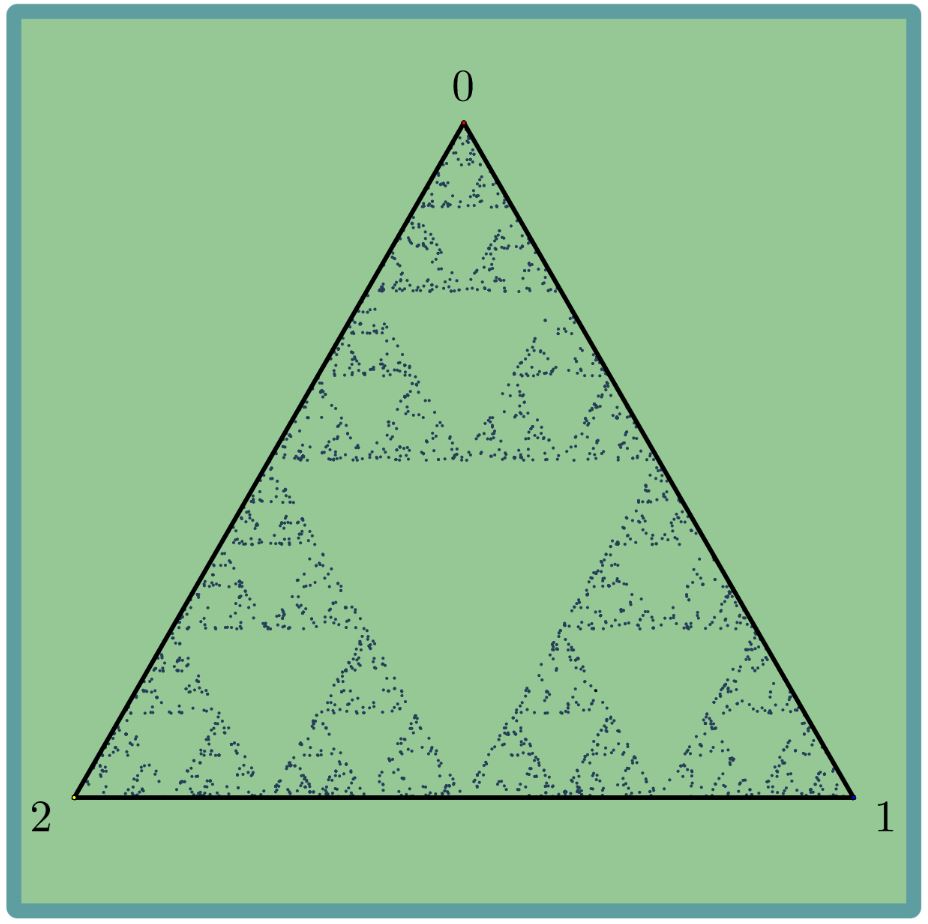
 and
and  be the vertices of a triangle
  and choose a random point
  in the triangle. Next, choose one of the triangle vertices uniformly at random and move
  half of the way towards it – we denote this point by
  . We now repeat this step infinitely many times – given the point
  we choose uniformly at random a vertex from
  , move
  half way towards that vertex and denote this point by
  .
. 

 a word
  over
over  and then the message
  is coded to be
  . This leaves us with the question of what is the best that we can hope to gain this way?
 is actually a Euclidean norm and we were led to study the embeddings of rings such as
 ![\mathbb{Z}[i], \mathbb{Z}[\omega]](https://s0.wp.com/latex.php?latex=%5Cmathbb%7BZ%7D%5Bi%5D%2C+%5Cmathbb%7BZ%7D%5B%5Comega%5D&bg=ffffff&fg=333333&s=0&c=20201002) as lattices in
as lattices in  . As mentioned there, not all rings can be nicely embedded in
  Ofir David